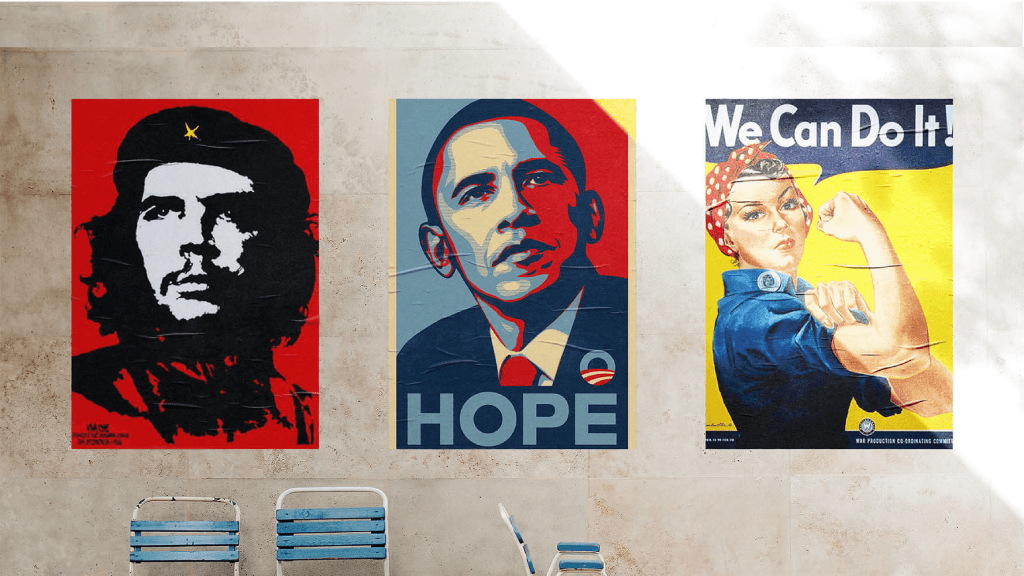
Propaganda. What springs to mind?
For me, and for the handful of people I asked, the answer was remarkably consistent: the World Wars. The speeches, broadcasts and, above all, the bold posters attempting to maintain morale, rally support and persuade the public to keep the wartime machine moving. One poster in particular came up several times – along with its now thoroughly exhausted slogan. Can you guess which one? To be revealed shortly!
Unsurprisingly, propaganda is nothing new. The term itself dates back to 1622, when Pope Gregory XV established the Congregation for the Propagation of the Faith, a Vatican department tasked with spreading Catholicism around the world. The practice it described, however – influencing thoughts and behaviour – is considerably older.
Take Ramesses II. His reputation as a great pharaoh rested heavily on his fame as a soldier. With expectations to uphold, he did what any self-respecting ancient ruler with a message to promote might do: he built enormous temples and statues across Egypt, turning them into colossal monuments to his military achievements.
If a battle didn’t quite go according to plan? No problem. Temple walls could simply depict a glorious victory instead. Why let inconvenient facts get in the way when you have an entire stone wall and a team of highly skilled artists at your disposal?

Ramesses II was far from the only ruler to embrace a little creative storytelling. Ancient rulers and civilisations were remarkably adept at managing public opinion. Enemies were portrayed as barbaric, bloodthirsty tyrants, while their own conquests were presented as noble missions to bring peace and order to the world.
If that sounds worryingly familiar, it’s because propaganda has never gone away – it has just evolved with the times and technology available.
Today, our already overstimulated brains are bombarded with more information, images and opinions than ever before – much of it delivered directly into our pockets via our phones. Messages designed to persuade us arrive constantly, often disguised as entertainment or news.
The objective remains remarkably consistent: shape what we think, influence how we feel and encourage us to act in a particular way. Often, it works by bending the facts, exploiting our biases and gradually wearing down our ability – or willingness – to question what we are being told.
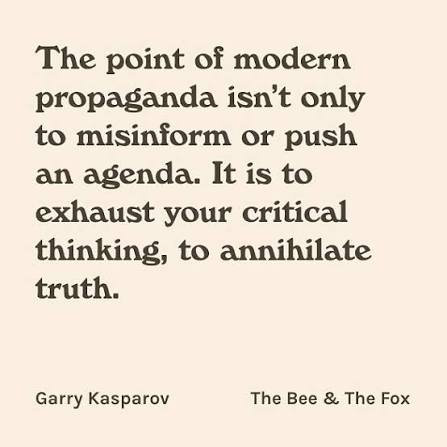
Propaganda also taps into something much deeper. Fear, hope, pride, guilt, anger and perhaps most powerful of all, our deeply rooted need to belong.
So, how did we get here? More importantly, can we find a way back?
The World Wars and weapons of mass communication
With propaganda’s long history, it is tricky to know where to start. Having mentioned a little ancient history, I think it is best to fast forward to the World Wars. Afterall, this was a period when its use was finely tuned to the difficult circumstances faced by the public.
During World War I, governments recognised that modern mass communication could be used to rally entire populations behind a cause. Mass printing meant posters could be produced quickly and cheaply and they soon appeared everywhere, from train stations to shop windows, schools and factories. Their messages were clear and direct, urging men to enlist, women to support the war effort and families to ration supplies.
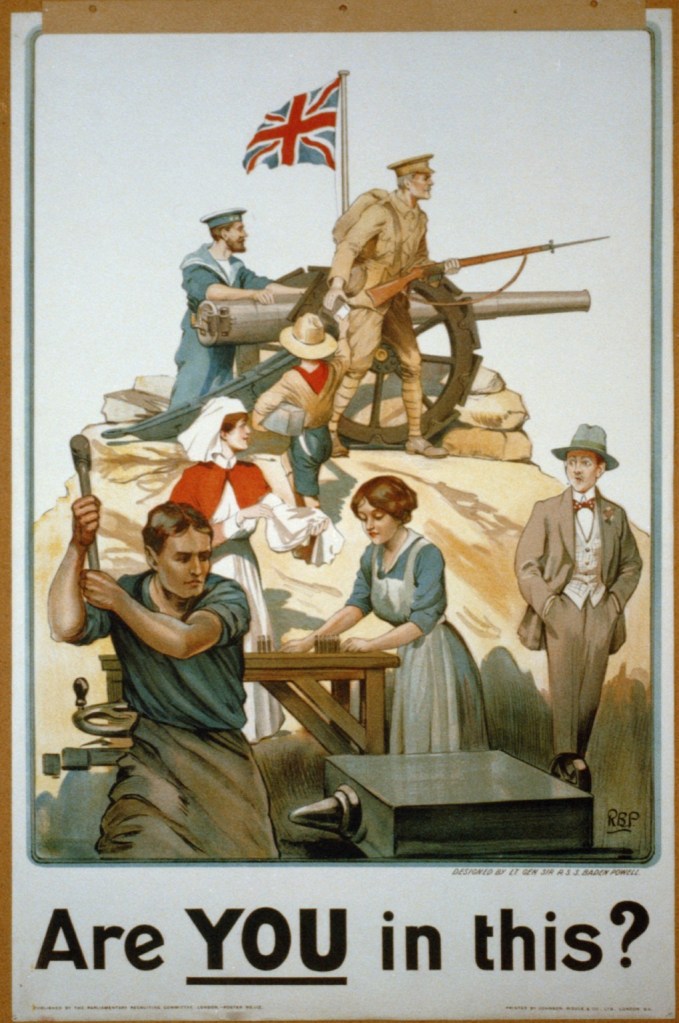
By World War II, propaganda had become even more sophisticated. Britain’s newly formed Ministry of Information (MOI) was tasked with producing and distributing propaganda at home and abroad. It coordinated films, pamphlets, radio broadcasts, thousands of public meetings, exhibitions, newspaper messaging and, of course, the trusty poster – all designed to maintain morale and shape public behaviour.
Some messages focused on resilience and unity. Others deliberately played on fear and suspicion. Civilians were encouraged to remain vigilant, avoid ‘careless talk’ and accept hardship as part of their patriotic duty.
The public and press were not exactly rolling out the red carpet for the MOI. Concerns about the Ministry delaying, controlling or censoring information were widespread. Those worries only grew after its first publicity campaign was poorly received. Posters intended to boost morale and reassure the public seemed to have precisely the opposite effect.
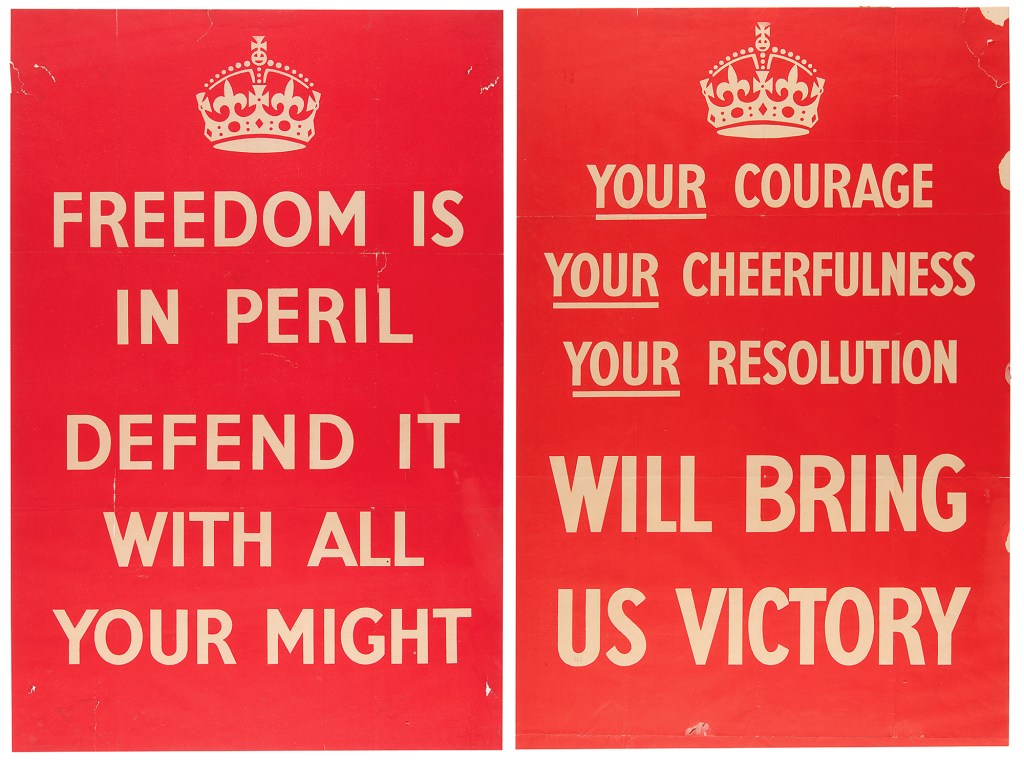
Part of the criticism centred on class. The lower classes were being asked to make profound sacrifices almost immediately, while many of the wealthier classes had yet to feel the full impact of the war.
Due to the backlash, the third poster in the series was not officially released during the war. It only resurfaced decades later, in the early 2000s, when a copy was discovered in a bookshop. In case, you hadn’t guessed it…
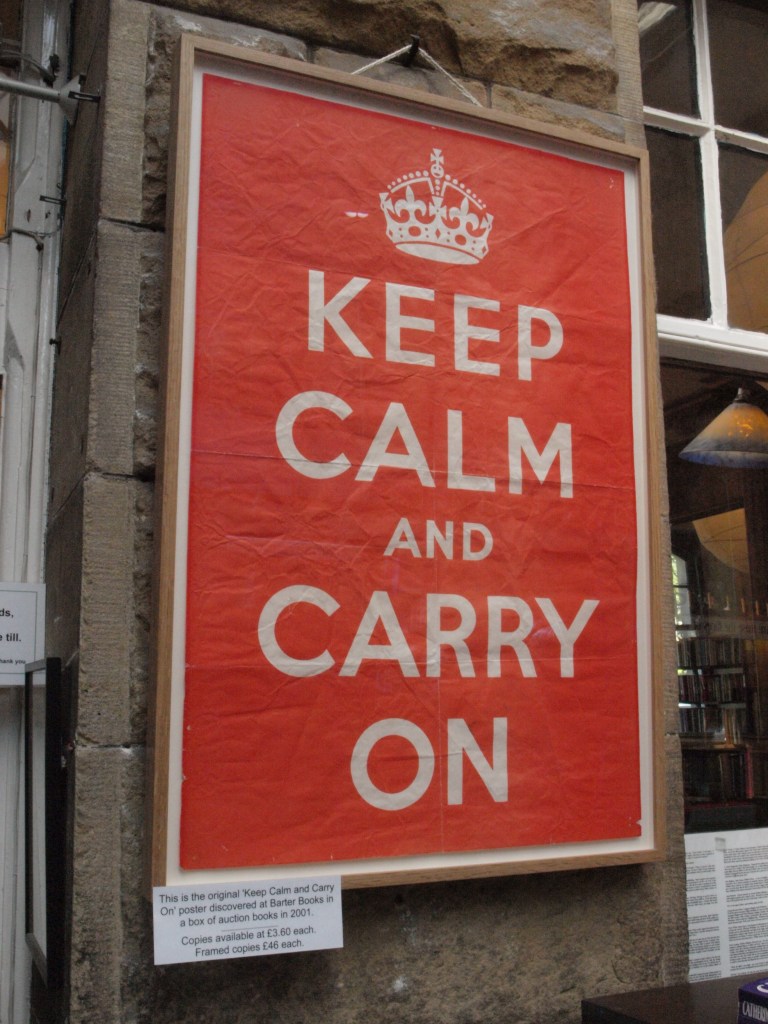
It has since become one of the most recognisable wartime posters, reissued and repurposed as a decorative theme for pretty much anything you can think of. Mugs, cushions, t-shirts, tea towels, pet toys, keyrings – the list really does go on!

Despite the rocky start, later MOI campaigns were better received, as the government adopted new and more varied ways of communicating with the public.
One particularly influential development was the Public Information Film, or PIF. These short films were designed to educate, inform and boost morale, and were shown in cinemas, factories, social clubs and other public spaces.
Some dealt with practical matters, such as how to correctly fit a gas mask. Others showed the realities of wartime life, including the effects of the Blitz on civilians. Then there were the PIFs that went considerably further, using stark and sometimes jarring images of destroyed streets, exhausted refugees, starving children and serious injuries to drive their messages home.
Following Germany’s surrender, the Ministry of Information was dissolved, with its remaining functions transferred to the Central Office of Information.
Despite the criticism it attracted throughout the war, the MOI had demonstrated the power and potential of coordinated public information. The government clearly saw value in continuing that work and public information campaigns lived on long after the Ministry itself disappeared.
Public Information Films – nightmare fuel for all
The horrors of the World Wars may have gradually faded into the background, but that didn’t mean the next generations of British children were going to escape the nightmare fuel of the PIF.
Early post-war PIFs had fairly sensible jobs to do. They encouraged people to continue rationing, explained how taxes were being spent and tried to keep the public hopeful during a difficult period of economic uncertainty.
Then there were the films about danger, some of which were surprisingly graphic, aiming to illustrate what could happen when everyday curiosity or carelessness went wrong.
Take Playing with Fire from 1947. This ten-minute extravaganza manages to make childhood curiosity feel like the opening act of a horror film – or at least the start of an episode of Casualty. We see young children happily playing, both indoors and out – however, don’t let this fun fool you. The film continues in a case study fashion, demonstrating how quickly innocent play can turn dangerous. Following each accident, we are treated to a shot of a racing, wailing ambulance, followed by another of a hospital ward, filled with small, empty beds. Subtle.
During the 1970s and 1980s, PIFs began to lean even further into scare tactics. If you grew up in the UK during these decades, there’s a good chance at least one Public Information Film is still lurking somewhere in your subconscious. Scared of abandoned fridges? Worried about being sucked into the side of an escalator? Blame a PIF! I’ve included links to some of the scariest PIFs (and a couple of funny ones for relief!) below.
Give them a go if you are feeling brave!
Lonely Water (1973)
This film featured a ghostly Grim Reaper figure luring children toward ponds, rivers, and lakes. The whispered line – “I’ll be back… back… back…” (long before Arnie said the shortened version with – somehow – much less menace!) still sends a shiver down many British spines.
The Fatal Floor (1974)
I did find this one unintentionally hilarious. The dangers of putting down a rug on a polished floor.
“Polish a floor, put a rug on it. You might as well set a man trap!” A man, his wife and their newborn visit a relative’s home, where the new father promptly slips on the rug. Rugs. The silent, fluffy killers.
Apaches (1977)
Often described as one of the most disturbing PIFs ever made, Apaches was created specifically for children in rural areas and therefore had a less mainstream release (thankfully). The objective of this 27-minute fright fest was to demonstrate the dangers of playing on farms and followed a group of six children playing cowboys and Indians.
In full on Final Destination style, the children are picked off one by one. While there were no faulty sunbeds or unfortunate gymnastic accidents, incidents involving tractors, slurry pits, chemicals and farm machinery made light work of the young cast. Seemingly oblivious to the deaths of their friends, the remaining children carry on playing until only one remains (“Have you seen this boy?”).
What really stands out in this one is just how matter of fact it feels and the way that the adults do nothing to protect or rescue the children.
I couldn’t find the full video of this – however, I did find one showing all the deaths! Enjoy!
The Finishing Line (1977)
1977 really was a scary year to be a child. Not only did you have Apaches, The Finishing Line also came out. A full 20 minutes of watching from behind your fingers. This one was banned for being too graphic – this shouldn’t really come up when making a film aimed at children.
A young boy who had recently been warned of the dangers of railway lines imagines a school Sports Day on a railway track. In his disturbing daydream, children compete in increasingly dangerous railway-themed games while adults look on approvingly. Games included throwing stones through the windows of a moving train, with points being scored for hitting passengers. Bonus points if you hit the driver! The final game consisted of the remaining (mostly injured) children limping their way through a long tunnel before a train arrives, presumably hitting those that failed to make it through in time.
The film ended with lifeless bodies being carried away presumably by the children’s parents. This feels less like a safety campaign and more like Squid Game with less budget and no giant piggy bank.
I couldn’t even find the full version of this either – perhaps for the best!
Did these scary PIFs work? Seemingly so.
Many people who saw these films as children still remember them decades later, often with surprising clarity. The fact that a short film watched once on a Saturday morning can remain lodged in someone’s brain for 40 years probably tells us something about the power of a good scare.
By the 1990s and 2000s, thankfully, the tone of most PIFs had softened considerably. Cartoons, humour and gentler storytelling began to replace outright terror.
I remember one from my own childhood featuring a firefly named Frances who accidentally set fire to her village. She was told off, everyone learnt their lesson, the village was rebuilt – all without a single, horrifying death!
In the 1990s, we were even treated to the wonderfully surreal world of mock PIFs, including those created by Harry Enfield (and Chums!)
More recently, I stumbled across this funny one from Yorkshire Tea, which appeared on my feed shortly after I’d been discussing PIFs…technology really does listen!
From public broadcast to personal feeds
Propaganda, like all forms of communication, continues to evolve.
Instead of being broadcast from a handful of television channels or carefully coordinated by government departments, persuasion now comes at us from almost everywhere, all at once. Social media has turned every user into a potential publisher, commentator, advertiser or – the word that probably wraps all of this up rather neatly – influencer.
Information no longer arrives in neat, curated packages. It floods in continuously through notifications, videos, adverts, podcasts and algorithmically selected content. This is perhaps one of the most concerning elements – the algorithms are paying attention. They learn what we like, what we react to and what keeps us engaged. They then serve us more of the same.
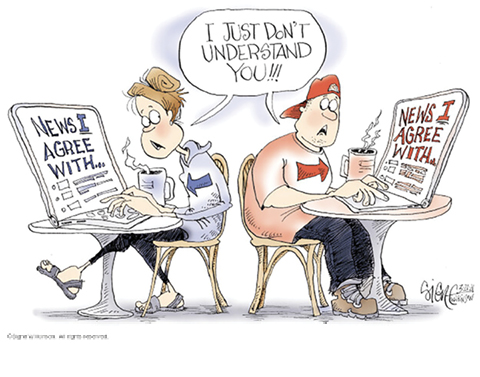
This is where the term ‘echo chamber’ comes in. The more we are shown content that reinforces what we already believe, the more familiar and convincing those ideas can become. Opposing views, meanwhile, may appear increasingly rare and when they do pop up, they can seem more extreme or hostile than they actually are. The result is a communication landscape where truth is competing directly with something arguably more powerful – engagement.
Along comes AI
Just as society was beginning to grapple with misinformation online, Artificial Intelligence (AI) threw its hat into the ring.
AI isn’t as new as you may think. The core concept dates back more than 80 years, with early mathematical models of ‘artificial neurons’ emerging in 1943 – long before the days of the Terminator franchise (I’ve popped a few references in from this classic series – would you rather downright creepy AI with Jude Law? Shudder.)
It’s only in recent years that AI has moved from something largely confined to research labs and specialist industries into our everyday lives. The arrival of widely available Large Language Models (LLMs) in the 2020s – capable of generating human-like text, code and images – brought AI firmly into the mainstream.
AI can summarise information, generate artwork, write articles, translate languages (very handy during holidays!), clone voices and create remarkably realistic video footage in minutes. Used responsibly, it has enormous potential for education, accessibility, healthcare and creativity.
Of course, there is another side to this technological leap. The same tools that can help us create can also make it easier to fabricate. Deepfake technology can place real people into entirely fabricated situations with alarming realism (although – not always).

Fake speeches, manipulated interviews and AI-generated images can spread online like wildfire – often much faster than fact-checkers can investigate and debunk them.
That leaves us with a rather strange new reality. We are entering an era where seeing is no longer necessarily believing.
What happens next?
Faced with constant information, targeted advertising and endless scrolling, people are beginning to push back. A quiet digital rebellion seems to be emerging.
There is a pleasing, growing demand for the humble ‘brick’ phone – a device that does little more than make calls and send texts. Think your trusty old Nokia from 2005, when the height of entertainment was a few rounds of Snake. Oh the nostalgia. Although, let’s hope the polyphonic ringtone doesn’t return on the back of Snake.
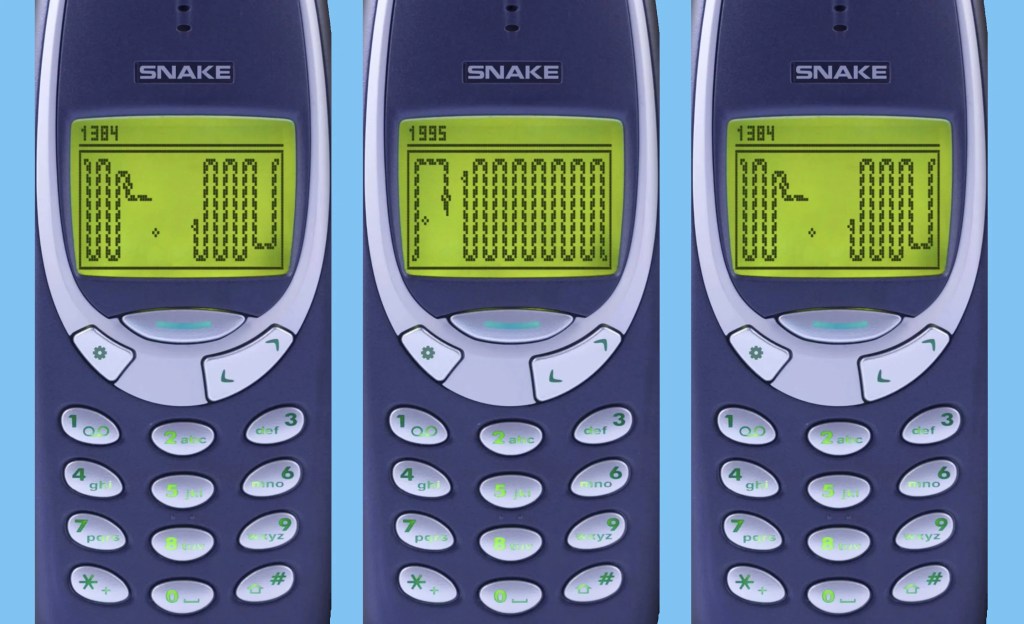
Others are deleting apps, switching off notifications or setting limits on screen time. Not because technology is inherently bad, but because our brains were never designed for this level of constant stimulation.
So, where does that leave us?
Propaganda, relentless communication and the dreaded ‘fake news’ aren’t going anywhere. The difference is that we are becoming more aware of how they work and (hopefully), a little better at spotting them.
Perhaps that’s the real evolution. Not a world without propaganda, but a world where more people recognise it when they see it.
So, next time you find yourself doomscrolling at midnight, staring at yet another cat video or outrage-inducing headline, it might be worth pausing to ask:
Who wants me to believe this and why?
Then maybe put the phone down for a bit. Your brain will probably thank you for it.
One more for the road…



Leave a Reply