
Another year has gone by and, as always, I’ve been keeping an ear out for words that I’ve found appealing – whether ancient, new or previously unknown to me.
Of course, there are always the official words of the year. Oxford University Press opted for “rizz” – a shortening of charisma, pertaining to someone’s ability to attract another through style, charm or attractiveness. Tom Holland certainly did his bit to propel this the popularity of rizz.
First recorded in 2022, rizz went viral in June after the Spider-Man actor declared in an interview:
“I have no rizz whatsoever. I have limited rizz.”
Holland’s comments spawned endless memes and the word can now be found all over social media.
Meanwhile, the Cambridge Dictionary opted for “hallucinate” – not relating to an altered state of mind, but instead to AI hallucinations. This type of hallucination is a response generated by an AI which contains false or misleading information presented as fact. You may have encountered this through chat bots such as ChatGPT, where plausible-sounding random fibs pop up in the content generated. Try it on a topic you know – some very strange things can pop up! However, they can sound convincing which is the problem.
AI really warrants a whole piece on its own. It’s all moving so fast and can be alarming, especially for those that work within the creative industries. I’ll do my best to refrain from that rabbit hole for the time being but watch this space!
Now, on with my list!
Sonder
With our busy lives, commitments and changing circumstances, it can be hard to take a step away from the main character mentality which can easily creep in. After all, we (or perhaps our immediate dependents) are the centre of our lives with unique hopes, dreams, fears and struggles.
However, once we do take a step back, we can obtain the realisation that everyone is leading a life just as complex as our own, continuing a narrative that we have no personal awareness of. The word for this is “sonder”. Coined by John Koenig in “The Dictionary of Obscure Sorrows” sonder is one of the many words he has created to describe emotions that lack specific vocabulary in the English language.
It can sometimes feel the world is against you and feelings of resentment pop up towards strangers that are seemingly having a better time than you are. However, how much do you really know about what is going on in their lives and what they may be dealing with? The fact is that we don’t know anything about their situations – how could we? We are background characters in their lives, just as they are in ours.

This can feel hugely isolating, but there is something that joins us all together if we open ourselves up – shared human experience. As we go through life, we collect experiences – both good and bad. The chances are that we’ve been in a similar position to the people that we see around us. I guess the takeaway message here is to open and lead with empathy. Through this we can form a sense of unity and appreciate the intricacies of what it means to be human.
Dinner medals
Introduced to my vocabulary via a podcast, dinner medals are the stains gifted by dropped food from your last meal. Whether acquired through a Sunday roast, a curry or a messy dessert, these medals are seemingly attracted to light coloured clothing and serve as a reminder that you’ve misplaced your serviette.
I for one have been awarded many dinner medals over the years, with one particularly proud mark being gained upon the first spoonful of waffle and ice cream dessert while out with two friends. As I excitedly went in for my first mouthful, I dislodged a hidden chocolate covered strawberry, which rolled off the table and across my light grey jeans – seemingly in slow-motion.
The resulting stain was in a position which dodged the coverage of my coat and so I received a few odd looks as we shopped around the busy town centre afterwards.
At least calling such stains ‘medals’ hints of a level of achievement. I’ll take that!
Perendinate
We all know what it means to procrastinate – to put something (usually an unwanted job) off until tomorrow. Surely the motivation to get it done will have appeared by then and we’ll be super motivated…
However, should an extension be needed, one can be gained through the use of ‘perendinate’ – putting something off until the day after tomorrow! Finally, a more realistic target!
Side note: would ‘’The Day After Tomorrow’ be a better film with this snappier one-word title? I’d like to think so.
Irusu
Picture the all too familiar scene – you are finally home after a busy, stressful day and you settle down for a little time for yourself. Suddenly the doorbell rings unexpectedly. Do you answer it? Or do you move to a different room or sink down into your seat and pretend to be out?
Perhaps more prevalent or generally more accepted in Japan, they created a word for this dodging behaviour – “irusu”.
With modern technology providing a background of constant noise, we have become used to always being “on-call”, available to friends, family and marketing spam at all hours of the day. Ignoring digital messages is one thing – when someone uninvited comes into your physical space it can feel particularly intrusive.
This is upped when the person ringing your doorbell is unknown to you, but then waves to your door camera. The smug people that do this probably deserve their own unique word and not the usual few that I utter under my breath upon watching my Ring playback!

Fudgel
Continuing the theme, fudgeling occurs when you pretend to be in deep concentration while at work when, in reality, you aren’t actually doing anything. This can be alarming if you’ve slipped into a fudgel state without realising, only to be disturbed by a random question or a phone call.
I couldn’t find much on this one, although some sources suggest that it stems from the 18th Century, which I find reassuring. Long before social media scrolling and the endless distractions we have today, people in the 1700s felt the need for a term to describe idling away their hours, finding ways to avoid the things they should really be getting on with.
Kalopsia
Based on ancient Greek, kalopsia refers to the state in which everything and everyone looks beautiful. How lovely to be able to wear rose tinted glasses and see the beauty in everything.
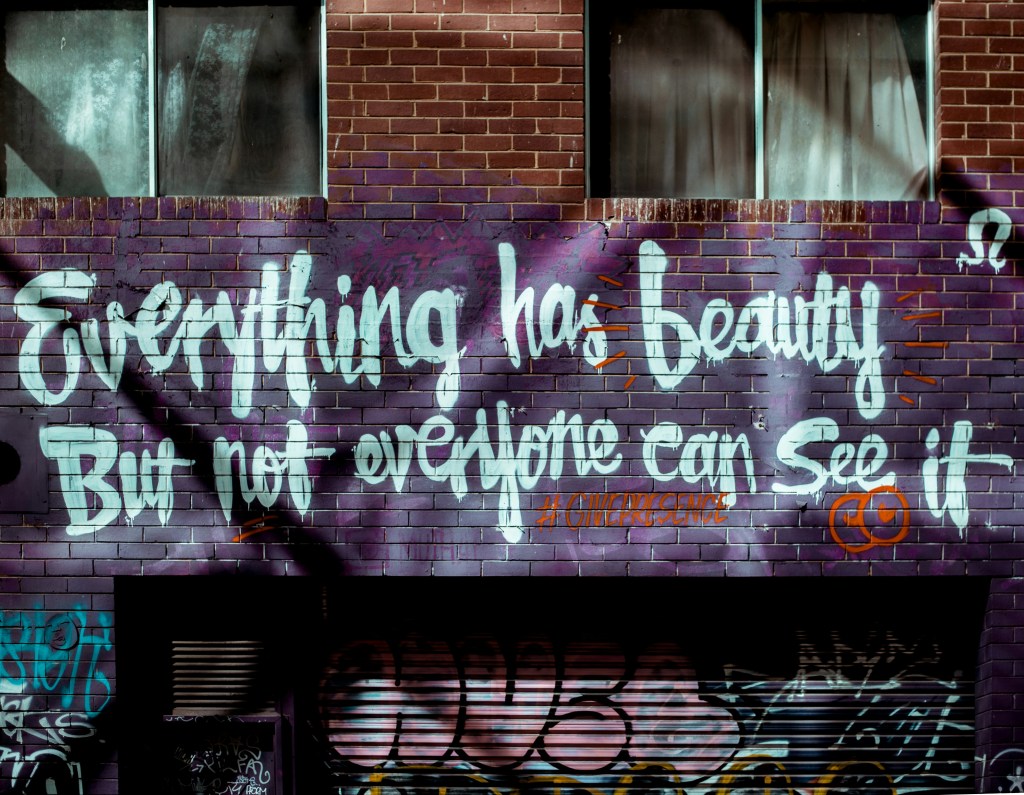
The video for Lily Allen’s LDN pops into my head at this point where unpleasant scenes are replaced by something more appealing and Disney like.
A bit deluded? Maybe, but sometimes we need a bit more Disney – after all, if one can see nothing but beauty around them, what a happier place the world would be.
Atrophying
Entering my vocabulary thanks to Sandi Toksvig and her reason for leaving The Great British Bake Off, atrophying relates to something wasting away – usually used in relation to body tissue or an organ.
In Sandi’s case:
“I was literally standing there watching meringues dry and thinking ‘Oh my God, my brain is atrophying. So, after three years, I thought ‘That’ll do; go and do something else!’”

Glimmers
The opposite of triggers, glimmers are experiences that make you feel safe, connected and settled. They are those moments of positivity that we can use to combat difficult situations or negative emotions.

The concept of triggers and glimmers exists within Polyvagal Theory, which was developed by Dr. Stephen Porges in the 1990s. Being able to recognise both triggers and glimmers in your daily life can be a game-changer for your mental health.
Everyone has different glimmers – cuddling with a pet, a favourite TV show, the sun on your face, feeling accomplished, seeing a rainbow. Our glimmers are unique to us and can help us feel reassured that everything will be OK. I urge you to take the time to recognise your glimmers and utilise them when you need a boost.
On which note – where is my hot chocolate and lap cat?
 Christine's Craft
Leave a comment