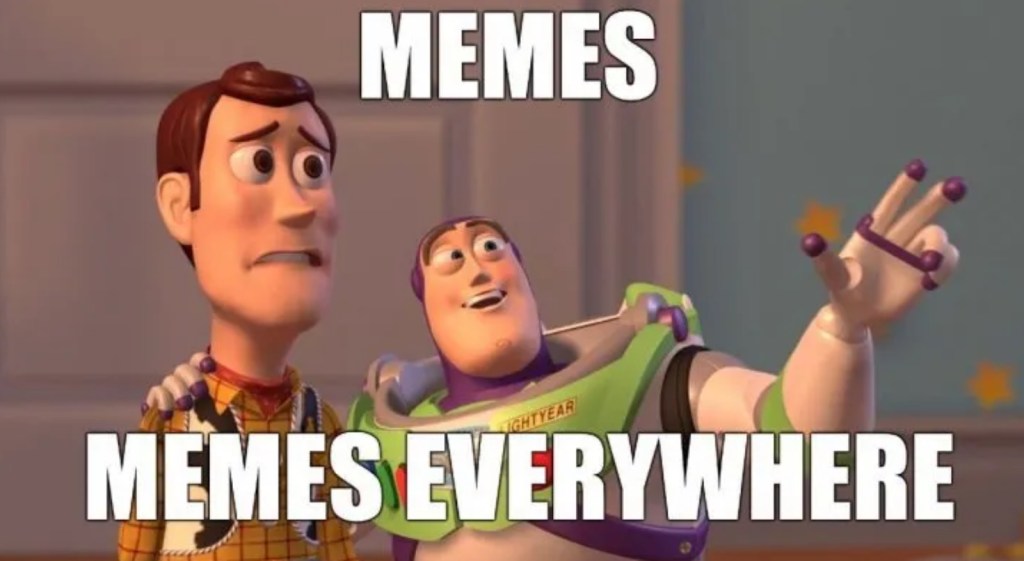
Social media. WhatsApp. Text. Email. Zoom. Skype. Teams and the inevitable “you’re on mute”. We have more ways to connect with one another than ever before.
This freedom (or perhaps lack of it), has been driven by improving technology. In the western world, most of us carry this technology in our pockets – a generous number of us (including me) probably feel the all too familiar panic if we venture out without our mobile.
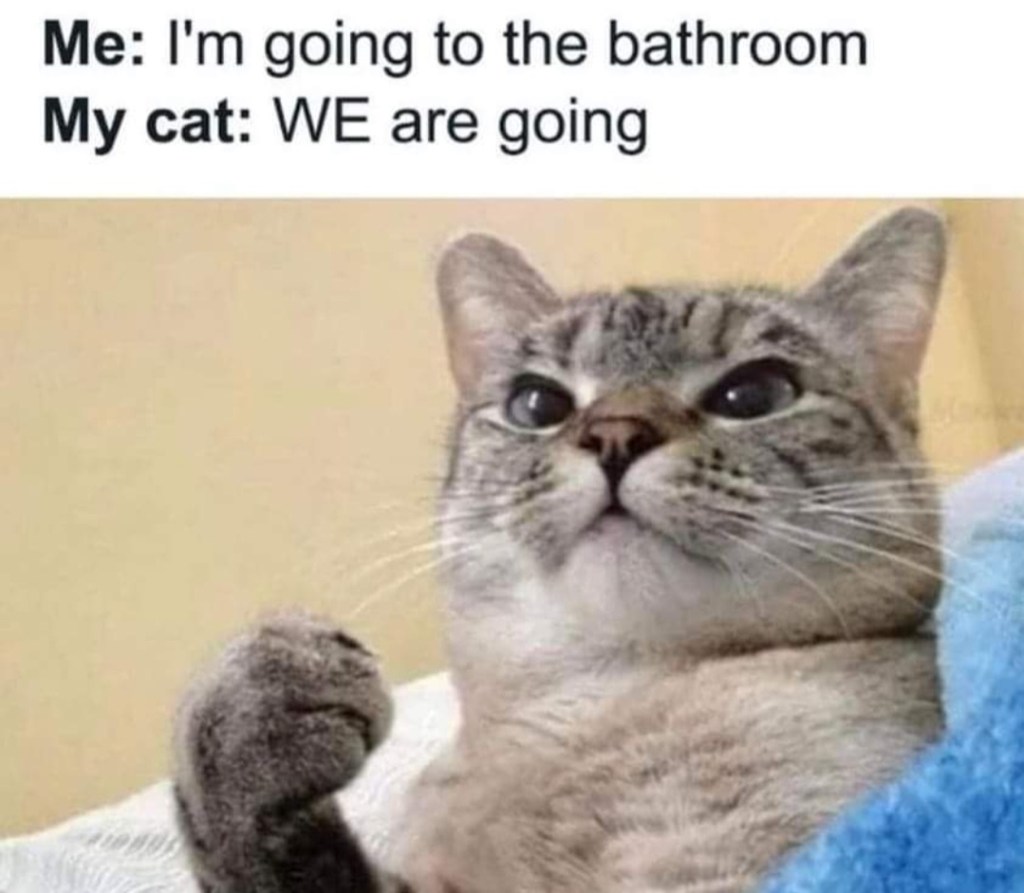
The way we communicate is shaped by the channels we use. It is here where we welcome the topic of this piece – the meme. I thought I knew a fair amount about memes, but as I researched, an increasing number of rabbit holes appeared. So here is an overview, complete with Rickrolling, Chuck Norris and – of course – the mandatory cat meme.
The history of meme
When you Google “meme”, you will be met with the intriguing titbit that the term was coined by biologist Richard Dawkins in his 1976 book on evolution entitled “The Selfish Gene”. Dawkins noted the way that genes use individuals, families and species as a vehicle in their quest for immortality. Hence, he labelled the genes as being, metaphorically, selfish.
Dawkins conceived memes (a shortening of the Ancient Greek “mimema” – “imitated thing”), as the cultural parallel to biological genes. The replication and transmission of a meme occurs when one person copies a unit of cultural information from another. This process leaves the meme open to evolution and mutation over a period of time, with the most successful memes becoming the most prevalent within a culture. Dawkins applied the theory to the communication channels available at the time – predominately books, newspapers, radio and TV.
Since the internet permeated our lives in the early 21st Century, there has been a renewed interest in the meme concept.
There is, however, a key deviation from Dawkins’ theory when applied to internet memes – instead of evolving randomly, internet memes are prone to deliberate alteration by people and groups. Due to this, today’s memes should probably be considered as a new representation of the meme concept.
What is a meme?
Memes are most often associated with an image or video that portrays a particular concept or idea. That idea goes on to proliferate through social media and other communication channels, with the meme often being altered and built upon. This can result in a meme obtaining a new meaning and representing a completely different idea.
With limited content creation tools, early memes revolved around singular pictures and concepts. These basic memes, which are still popular today, consist of an image overlaid by large text at the top and bottom. Some of the most popular early memes were the plethora of Chuck Norris “facts” – hyperbolic statements about his God-like status that were all the rage in the mid-2000s.
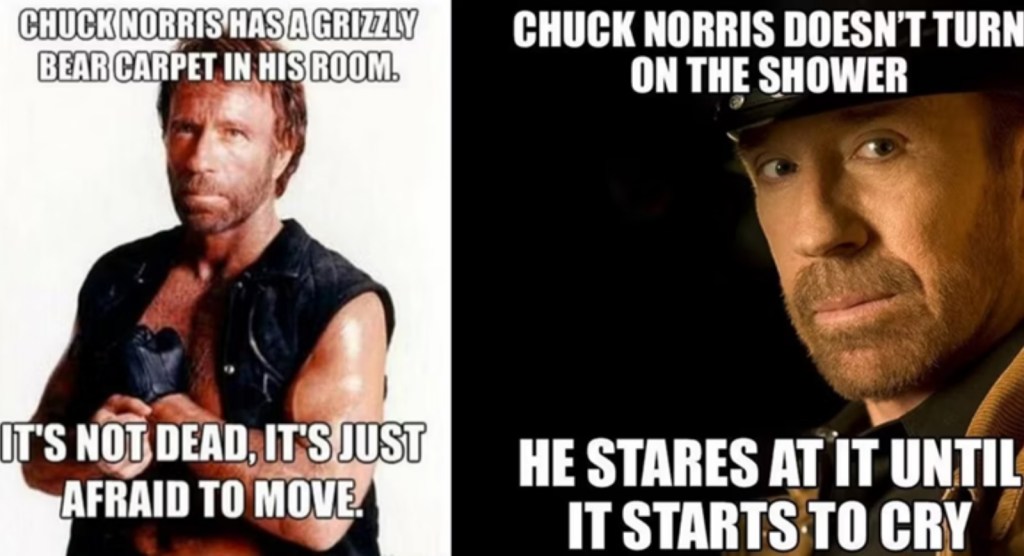
Don’t doubt the above – we all know that underneath Chuck’s beard there is no chin – simply another fist.
Subculture backlash
Memes really started to gain wide recognition with the rise of mainstream social media platforms, which allowed them to become more diverse and spread in all directions at once. The increased availability of improved technology also allowed memes to cross into the realm of video.
Rickrolling – where you click on a seemingly unrelated hyperlink, but end up on the music video for the 80s classic “Never Gonna Give You Up” – was one of the earliest video examples. The virality of this prank led to the Rick Astley hit gaining over a billion views on YouTube and opened the door for a cascade of other video memes.
Many previously niche memes filtered out from sites like 4Chan and Reddit – platforms with a large subculture, that created memes linked to their identities, language and ideologies. The adoption of these memes by the mainstream can be a source of friction for the originators, due to people from outside their community (“normies”) taking what was previously an in-joke and using it for their own ends.
Below is a chart taken Reddit, which highlights their opinion of a meme’s journey to the mainstream.
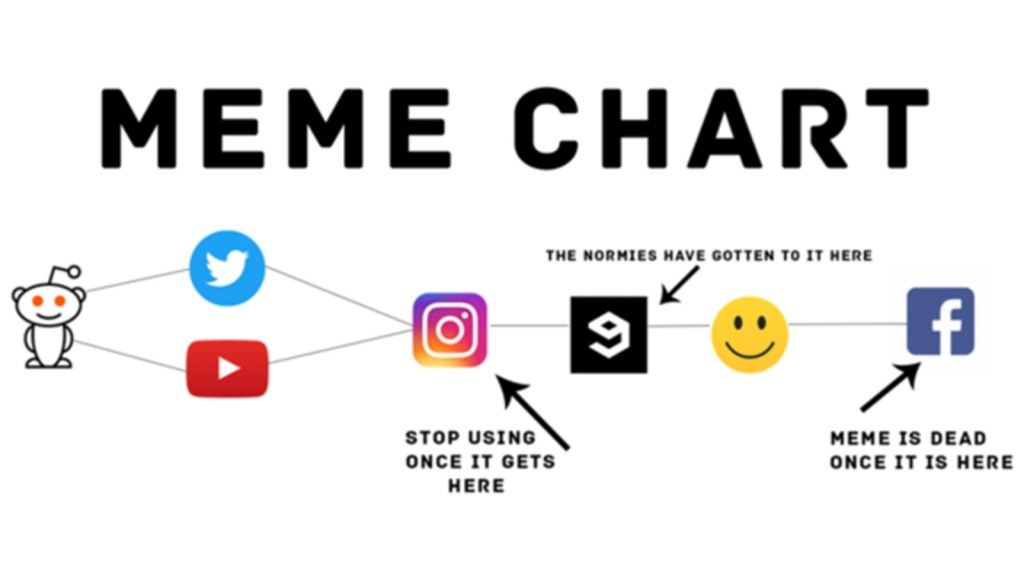
So, chances are that by the time a meme reaches the mainstream, the original creators have already stepped away from it.
Memetic marketing
As with all communication methods that can capture an audience’s attention, meme marketing (or memetic marketing as it has been christened) has gained traction, with several brands dabbling in the format.
There is good reasoning behind this – a 2022 study by Amra & Elma observed that the click-through rate of a good meme campaign is 14% higher than that of email marketing. This makes it the most effective tactic to boost return on investment.
The ultimate goal of any campaign would be to have a meme that goes viral – for the right reasons. A brand needs to know their market, their target audience and have their ear to the ground to be culturally aware of anything that could negatively impact their meme and the reaction to it – whether they choose to use an existing one or create something unique. As mentioned, as a meme evolves, so can the meaning behind it.
Nobody can claim to know or understand every single meme that exists. There are just too many, and they can often be too personal to the individuals or groups creating them.
Let’s take the example of “rice bunny” (米兔) – a collection of images and emojis which emerged in 2018 as part of the global #MeToo movement. With hashtags related to the campaign being subject to state censorship in China, internet users had to find an alternative way to coordinate the movement. Here is where rice bunny enters. A cartoon bunny next to, or sometimes in, a bowl of rice.
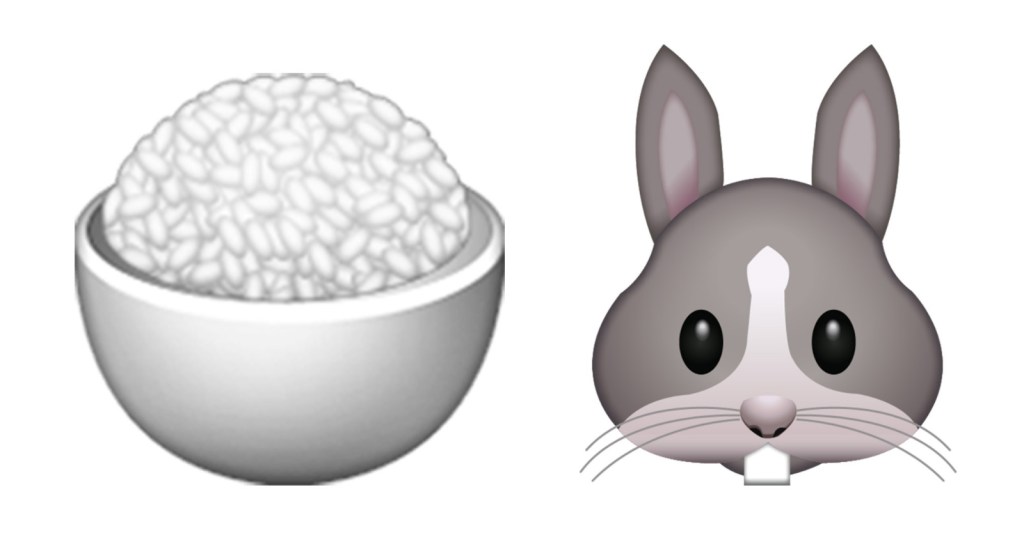
As an image it looks innocuous enough, but when the words for the two seemingly unrelated subjects are said aloud, the true meaning becomes clear – they are pronounced “mi tu”.
Hence, the importance of being aware of the hidden meanings of memes and the culture that they come from.
Creating a unique meme can be challenging as well – for a start, it won’t be recognised by your audience. It can work though. Understanding the target market and making sure that the meme is relatable to them is of paramount importance – a brand needs to be clued-up on the language the audience uses, the latest trends within the community and the in-jokes that may be circulating. Ideally, brands should look to capture a cultural moment within their meme and use it to amplify their message.
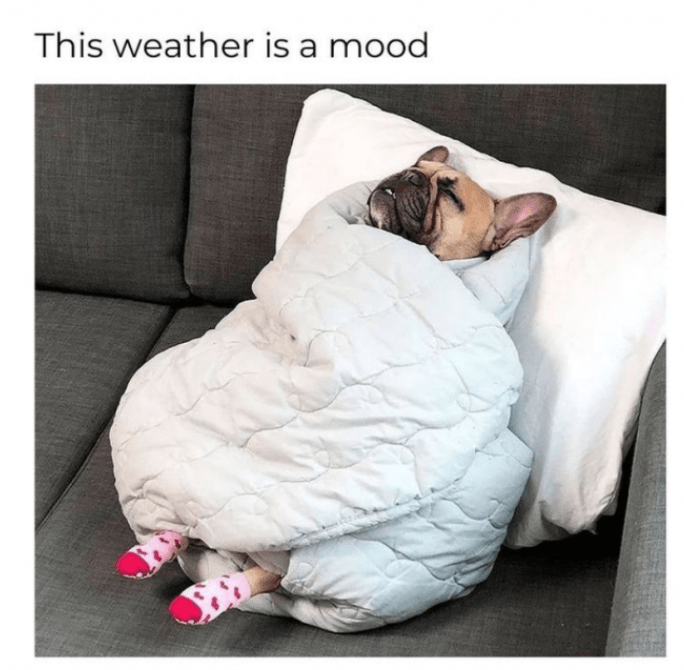
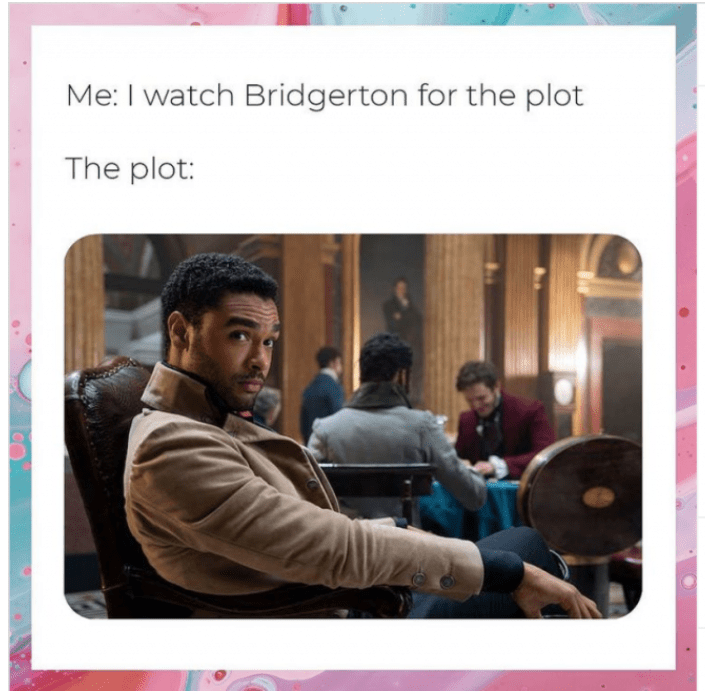
Very, the online retailer, enjoys posting memes. On the surface, their aim is less of a direct sales pitch and more of an attempt to connect with their followers. They apply a healthy topic mix of lifestyle, popular shows, current talking points and absurdity.
Very’s eye remains on the ball – they have even popped some of their brand colours on the background of the Bridgerton meme, circulating their signature whenever it is shared.
The future of memes
Memes, by their very nature, shapeshift at lightning speed and adapt to the new channels they are presented with.
TikTok videos are memetic in nature and have provided a new generation with an avenue to create such content. As time goes by, other communication platforms and channels will emerge, to provide new ways to unite the like-minded and provide even more content generation opportunities.
The power of the meme should not be underestimated. They can be a source for digital activism, from charity causes such as the ice-bucket challenge, to serious issues such as the #MeToo movement, Black Lives Matter and Stay Home (protect the NHS).
They can also be used to spread misinformation, like what was circulating during the peak of the pandemic or the various rumours around high profile politicians.
With modern technology and meme-generating websites, meme creation is something that anyone can partake in and use as a way to express themselves. Whether this be with positive or negative intent, memes will continue to adapt to suit our changing communication styles and culture. As Ricky Sans, Head of Memes at Instagram says:
“The future of memes holds infinite possibilities. We expect to see meme creators pushing the boundaries of new formats through creative experimentation.”
 Christine's Craft
Leave a comment